
Assignment 1
Part 1
I found the Harvard Art Museum website easy to use and explore. Each art piece in their collection has its own pag to showcase and store its information. These pages take a minimalistic approach, with its black & white color scheme and uniform navigation. The website begins with the piece’s name and image, and is then followed by numerous titbits of information regarding the piece. This description includes, but is not limited to, its “identification and creation”, “physical description”, “acquisition and right”, “provenence” and “public history”. The website displays the details of individual pieces in an easily digestible manner.
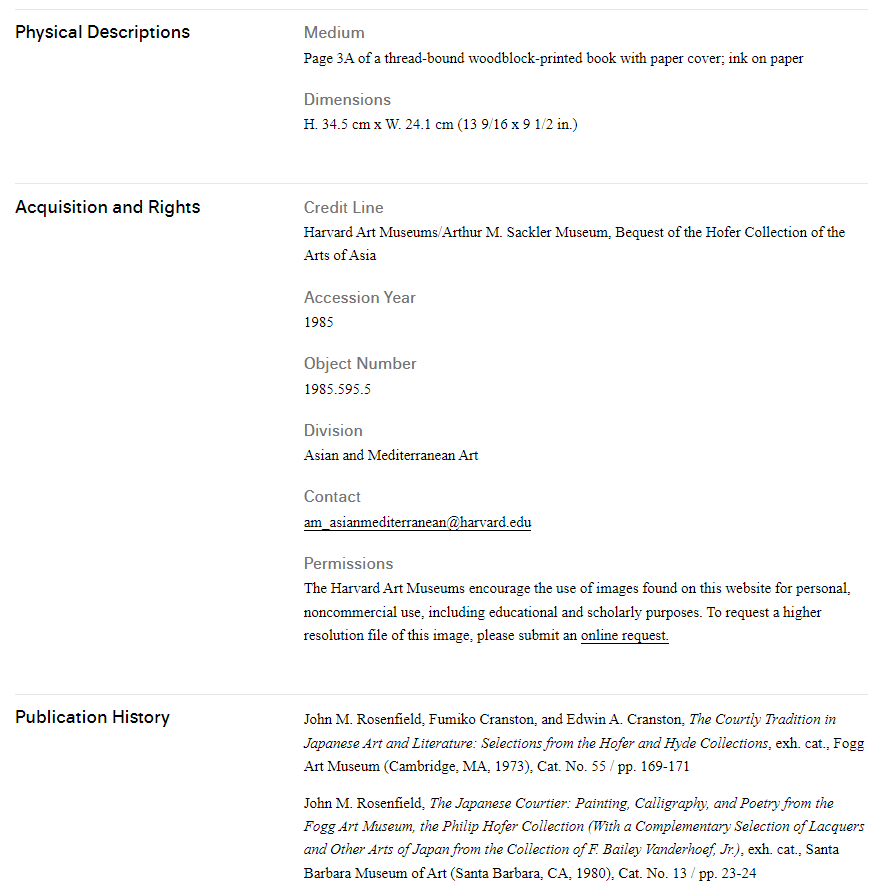 Poet Sosei Hōshi of the printed book of “Thirty-Six Immortal Poets” on HAM website
However, there are limitations to what can be gleaned solely from the interface. Researchers and scholars may require access to raw data for more in-depth analysis and research. A CSV file provides structured data that can be imported into analytical tools or programming languages for statistical analysis, data visualization, and computational research. Further, the spreadsheet format of a CSV file allows users to perform custom queries and filters on the data to extract specific subsets of artworks-based combinations of attributes, which is not nearly possible to the same extent on the HAM website. Museums also constantly change their catalogue of art pieces, but the accurate data logging of their inventory is paramount. Updating such details is much simpler and quicker in a csv file, where documentation is standard, rather than websites which are often specialised for the piece it is housing.
In conclusion, while museum websites is great in providing access to collections information for the public, a CSV file is better suited towards data analysis, interoperability, and data preservation. By making structured data available in standard formats, museums can help researchers, scholars, and developers to explore, analyze, and interpret collections data in meaningful ways.
Part 2
The All_Culture_information csv file revealed that the vast majority of pieces in the Harvard Art Museum’s collection have European or American origins, with East Asians also making up a significant chunk. It is hard to find pieces of African, Arab, Central American or South American roots. While I expected there to be a sizable difference in these populations, I did not expect it to be this large.
Could it be because European and American art has been better documented, studied? These demographics of art are more often supported by wealthy patrons, institutions, and art markets. This longstanding tradition of artistic production and patronage has contributed to the proliferation and preservation of European and American art collections in museums. Or perhaps, in their effort for repatriation, the Harvard Art Museum has returned many of the non-American and non-European artifacts back to their countries of origins, thereby dwindling their collection?
Another possible explanation could be that HAM is only interested in pieces of particular roots, as museums often prioritize collecting art and artifacts that align with their areas of expertise and research interests. HAM may find it challenging to acquire and contextualize works outside their sphere. Donors often have specific preferences or connections to certain types of art, which can influence the direction and focus of museum acquisitions. In this case, donors may be more inclined to support the acquisition of European or American art due to personal interests, cultural affiliations, or perceived market value. The HAM also gets more visitors from America or Europe, which may incentivise HAM to prioritize the display of American and European art to enhance visitor engagement with local pieces.
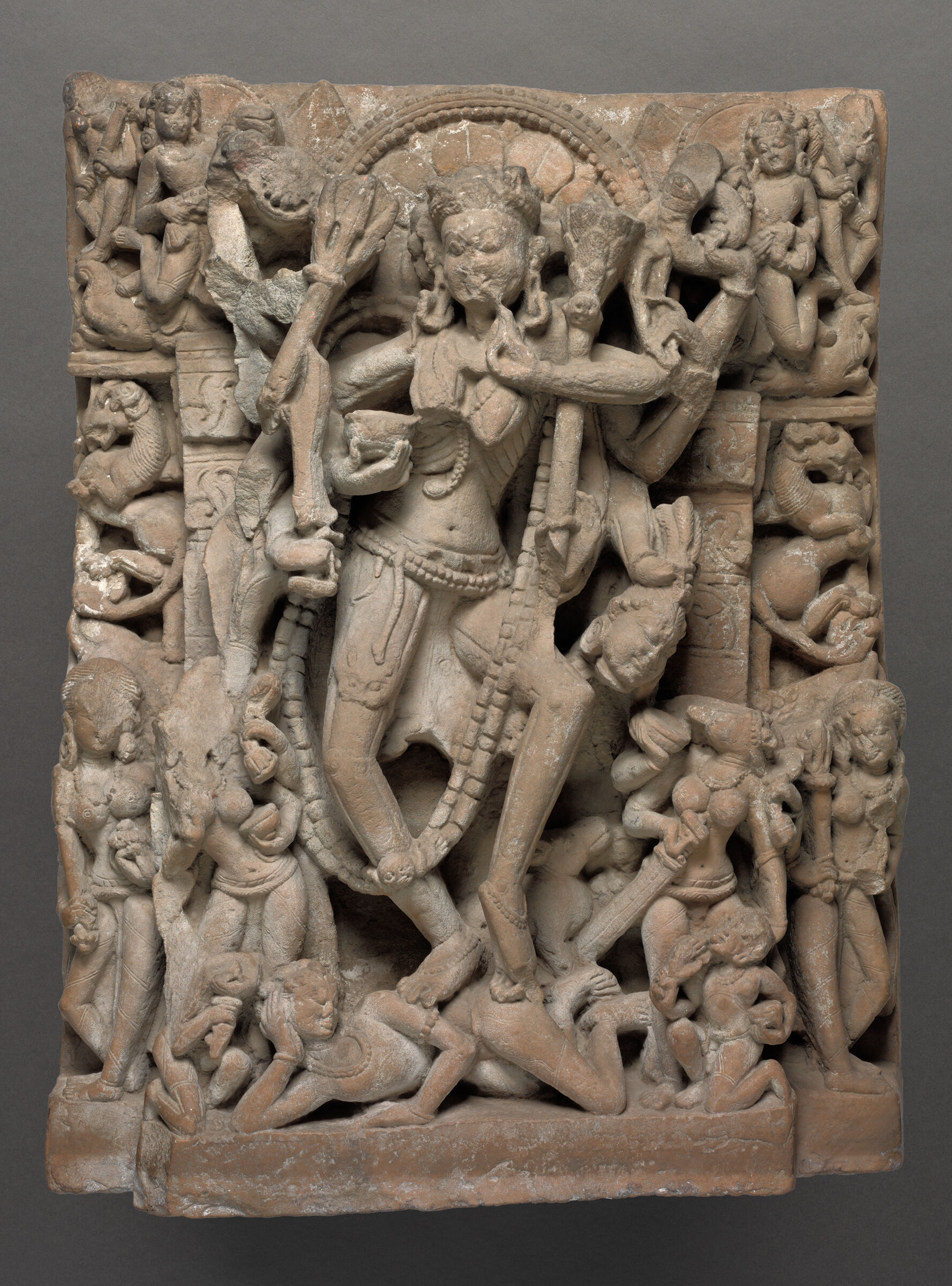 Architectural Relief with Chamunda
Since I am from India, I decided to choose Indian culture to investigate on the Harvard_API_All_objects notebook. The most viewed item is ‘Architectural Relief with Chamunda’, viewed 1914 times. I do not know much about the piece itself, but I know that Chamunda is a Hindu deity, often associated with death, destruction, and fierce aspects of Devi, the Mother Goddess. Depictions of Chamunda can be found in various forms of Hindu art and sculpture, especially in regions where Devi worship is prevalent. Chamunda is typically portrayed with a fearsome appearance, often depicted with a skeletal form, adorned with skulls and wearing a garland made of decapitated heads. She is usually depicted standing on a corpse or a demon, symbolizing her role as a destroyer of evil forces.
I am not surprised that a piece inspired by this famous and polarizing Hindu Goddess has garnered the most views, as she is a popular subject to depict. Her images can be found in temples, shrines, and sacred spaces dedicated to Devi and other deities. The deity embodies the paradoxical nature of the Divine Mother in Hinduism, encompassing both fierce and compassionate aspects. Through her depiction in Hindu art, Chamunda serves as a powerful symbol of protection, transformation, and the eternal cycle of life and death.
The least viewed pieces were ‘Head of Animal Figurine (with snout), from Sari Dheri’ and ‘Head of Animal Figurine (with pointed ears), from Sari Dheri’, each with 3 views. Most of the pieces from Sari Dheri are unpopular, having views in the single digits or low double digits. It refers to the archaeological artifacts site of Sari Dheri, an ancient settlement located in present-day Pakistan. Sari Dheri is known for its rich archaeological remains dating back to the Indus Valley Civilization, one of the world’s earliest urban cultures. Animal figurines are common among the artifacts discovered at various Indus Valley Civilization sites. These figurines depict a variety of animals, including cattle, buffalo, dogs, elephants, and mythical creatures. They were likely used for religious, ritual, or decorative purposes. Perhaps their unpopularity stems from the pieces’ lack of detail, with time chipping away at it. Undoubtably being some of the oldest pieces in the Harvard Art Museum, their lustre has been inevitably lost, and their history with it.
Part 3
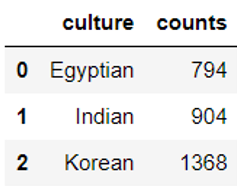
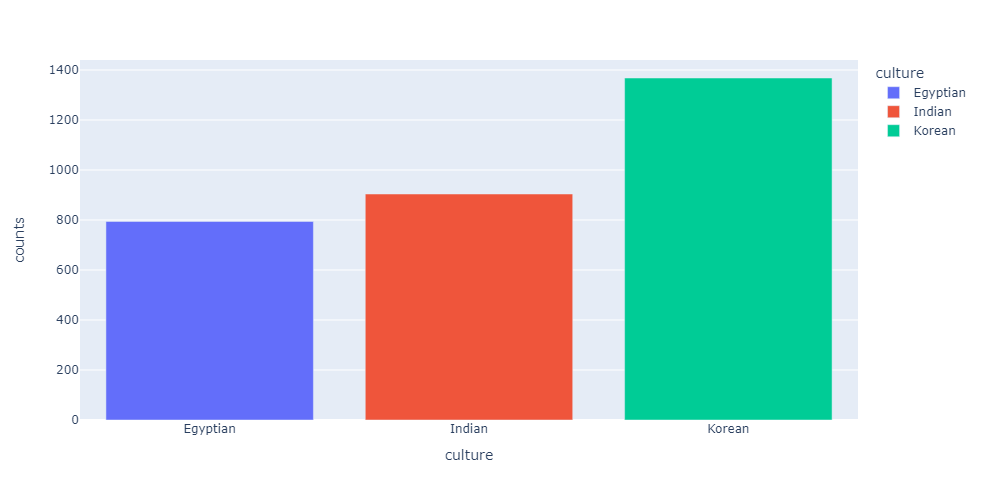 chart of cultures
In this section, I’ve chosen three distinct cultures: Korean, Indian, and Egyptian, as depicted above. These selections offer diverse cultural backgrounds, promising vastly contrasting word clouds. My aim was to curate cultures that possess comparable representation within the Harvard Art Museum collection. Each of these civilizations brings forth unique artistic traditions and historical narratives, enriching our understanding of human creativity and expression.
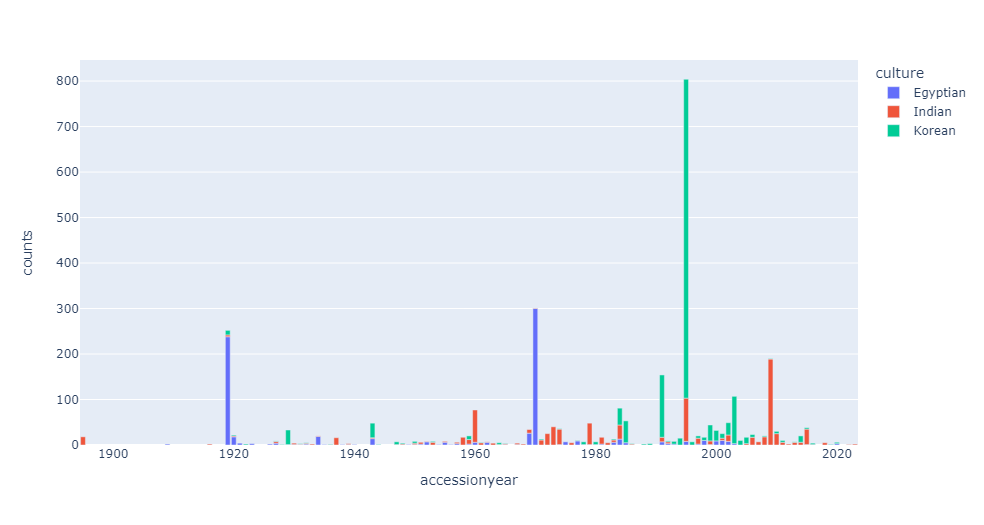 chart of accession year data of pieces from cultures
Above it is the accession year data and the time series bar chart. Most of the pieces obtained by the Harvard Art Museum seems to be in large bulk accessions. There never seems to be a steady flow-in of artifacts from any of the three cultures, but is instead large drops of pieces added to the collection. The museum also looks to have taken a more ready interest in the three cultures post 1970.
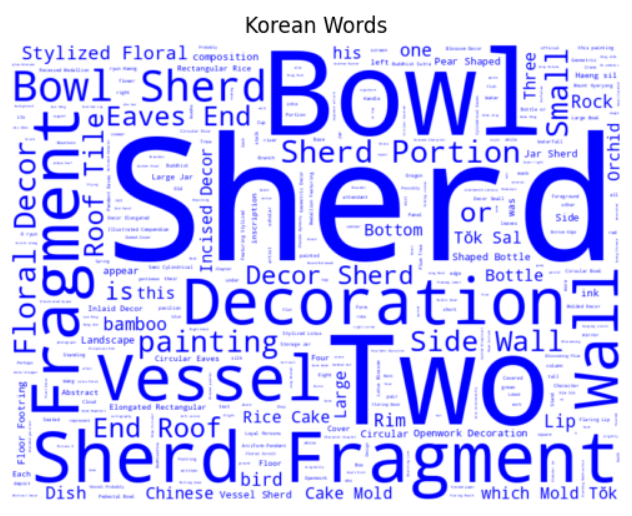 word cloud for Korean pieces
Stop words: “english”, “nan”, “of”, “the”, “a”, “from”, “with”, “i”, “are”, “for”, “it”, “and”, “to”, “by”, “that”, “on”, “Korean”, “in”, “an”, “as”, “at”
Above is the word cloud for artifacts of Korean culture. With “Sherd” and “Bowl” prominently featured, ceramics likely dominate the collection, possibly including decorative pieces, suggested by “floral” and “decor.” The appearance of “rice” and “cake” in the cloud is unexpected. Could these depict paintings or representations of culinary culture?
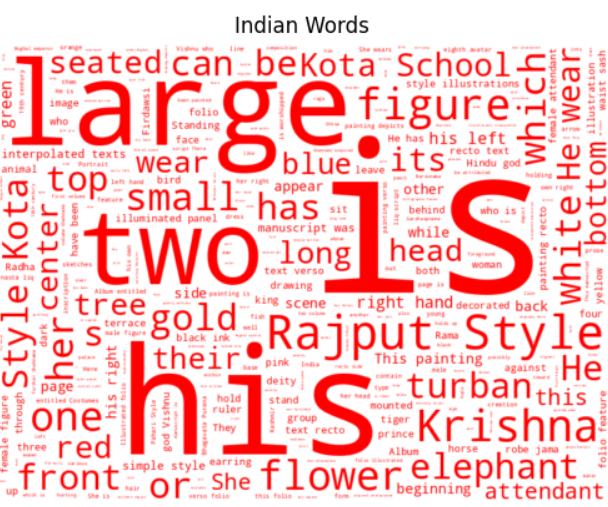 word cloud for Indian pieces
Stop words: “english”, “nan”, “of”, “the”, “a”, “from”, “with”, “i”, “are”, “for”, “it”, “and”, “to”, “by”, “that”, “on”, “Korean”, “in”, “an”, “as”, “at”
Above is the word cloud for artifacts of Indian culture. The presence of “manuscript” and “scripture” leads me to believe many of the artifacts were parchment or vellum documents. I was interested to see two distinct sub cultures from the Indian subcontinent; “Kota” and “Rajput”. The Kotas are an ethnic group indigenous to the Nilgiri mountain range in Tamil Nadu. Their religion and culture revolve around the smithy. The Rajput dynasty dominated northern India in the 7th century.
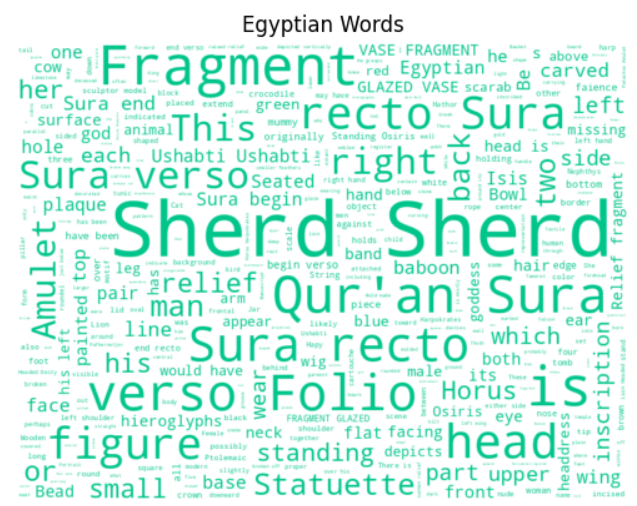 word cloud for Egyptian pieces
Stop words: “english”, “nan”, “of”, “the”, “a”, “from”, “with”, “i”, “are”, “for”, “it”, “and”, “to”, “by”, “that”, “on”, “Korean”, “in”, “an”, “as”, “at”
Above is the word cloud for artifacts of Egyptian culture. Like with Korean culture, “sherd” is prominent in the word cloud and likely also hints to ceramic artifacts dominating the collection. I was interested to see a mix of Islamic and ancient Egyptian concepts in the word cloud. Words like “Qur’an”, which is the Holy book of Islam and “Sura” which are chapters in the Qur’an, are alongside words like “Horus”, who is a sun god, and “Isis”, goddess of healing and magic, both from ancient Egyptian mythology. These concepts give us a window into the diverse understandings of the divine by the Egyptian people through millennia.