
Assignment 2
Introduction
For this assignment, I was excited to analyse a book series I had recently completed reading; the Farseer Trilogy, by acclaimed author Robin Hobb. The series invites readers into a captivating world where intrigue, magic, and political machinations intertwine. Set in the fictional realm of the Six Duchies, this epic fantasy saga follows the life of FitzChivalry Farseer, a royal bastard with a destiny intertwined with the fate of his kingdom. z As he navigates the complex web of courtly intrigue and battles against forces threatening the realm, Fitz discovers his innate talent for the ancient and mysterious art of the Skill, a form of telepathic communication, and the enigmatic Wit, a bond with animals. With richly drawn characters, immersive world-building, and a narrative that balances intimate personal struggles with grand-scale conflicts, the Farseer Trilogy is a spellbinding journey into a world where loyalty, betrayal, and sacrifice shape the destiny of nations.
In working on this series, I hope to uncover details I might have missed when reading the book.
Author
 Author Margaret Astrid Lindholm Ogden
Robin Hobb, the pseudonym of Margaret Astrid Lindholm Ogden, is a revered figure in the realm of fantasy literature, celebrated for her extraordinary storytelling prowess and profound world-building skills. Born in 1952 in California, USA, Hobb’s journey as a writer began with her early works published under her birth name. However, it was under the guise of Robin Hobb that she truly flourished in the fantasy genre, distinguishing herself as a masterful creator of richly detailed worlds and deeply nuanced characters.
Analysis
Assassin’s Apprentice
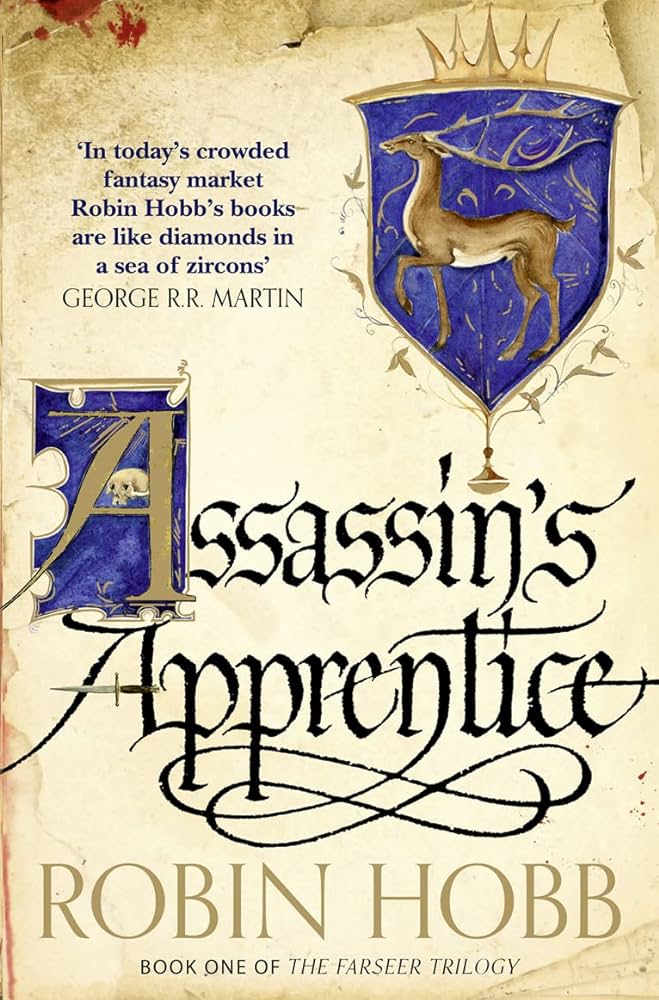 Assassin’s Apprentice cover — book 1 of the Farseer Trilogy
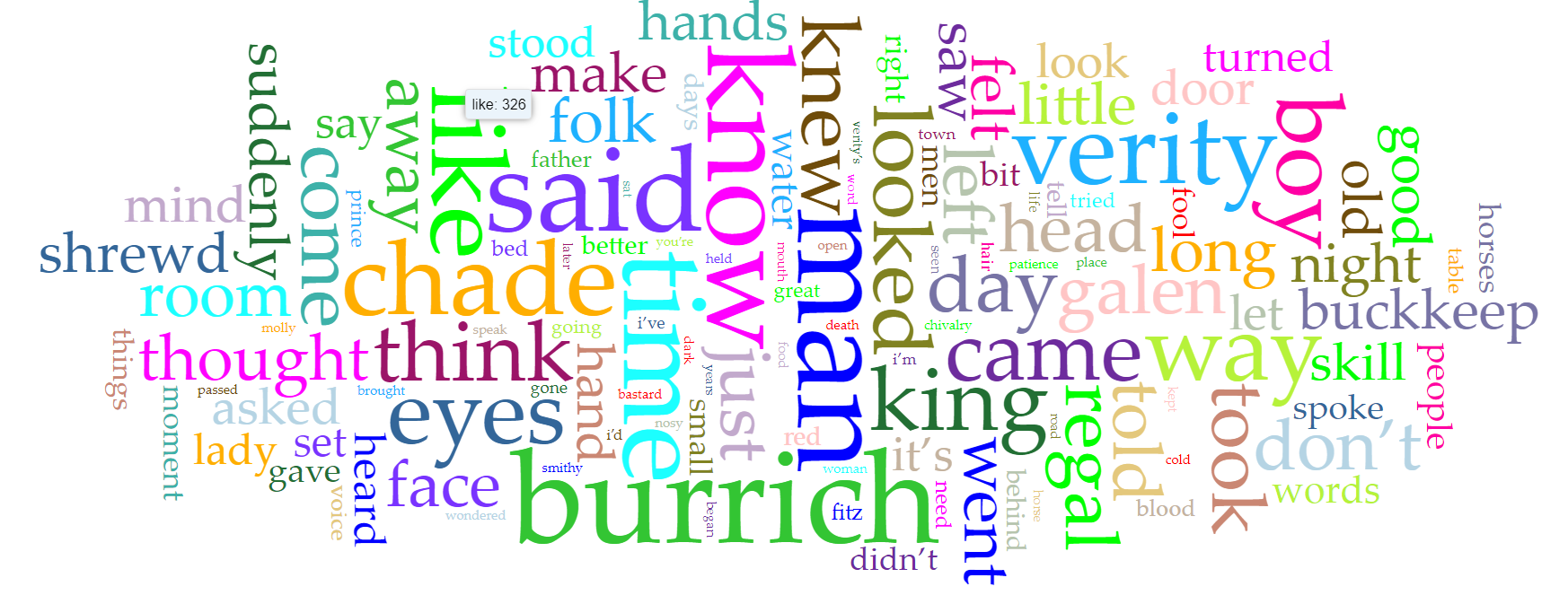 Word cloud of Assassin’s Apprentice
The story follows Fitz, the illegitimate son of Prince Chivalry Farseer, who is taken in by the royal family of the Six Duchies. Despite the shame of his birth, Fitz is trained as a royal assassin and diplomat by master Chade. The above word cloud displays the 125 most frequently used words in the book. From this, we can look at the most prominent characters in Fitz’s life, like Burrich, Chade, Verity, Regal, Galen, and Shrewd, who are his guardian, mentor, uncle, uncle, instructor and King respectively.
Burrich being the most mentioned (428 times), is Fitz’s primary guardian and who Fitz interacts with the most during the series. This makes since Fitz is six years of age in the beginning of the book, and needs looking after. Burrich works in the stable at castle Buckkeep, which are both alluded to in the word cloud, with the mention of ‘Buckkeep’ and ‘horses’.
Loom tool visualization of Assassin’s Apprentice
The interactive chart shows the frequency of each word distributed throughout the book. Using it we can deduct major events in Fitz’s life, and his everchanging relationship dynamics. I set the pre-set to “terms whose distributions vary the most”, to filter out the data I am more interested in. Also, it is usually changes in particular frequencies that suggest events unfolding in the book.
By following the yellow line, we see Chade’s introduction in the book as Fitz’s mentor. In his lessons learning to be a royal assassin for the monarchy, he latches on to Chade as parental figure. In the same section of the chart that Chade’s frequency peaks, Burrich’s frequency dips (green line), indicating a shift in Fitz’s relation to his guardian. This is exactly what happens in the book as during this time, Fitz is angry and scared of Burrich after he takes his dog away and believes killed, and so he avoids Burrich.
In the middle of the story we also see the narrow peak of ‘Galen’ (indicated by a red line). This indicates the beginning of Fitz’s tortured tutelage under Galen in the Skill, which is a Telepathic kind of magic in this world. We can also see the climax of the book near the end represented by the peak of ‘Regal’, Fitz’s uncle and the main villain of the series (indicated by light green line).
Royal Assassin
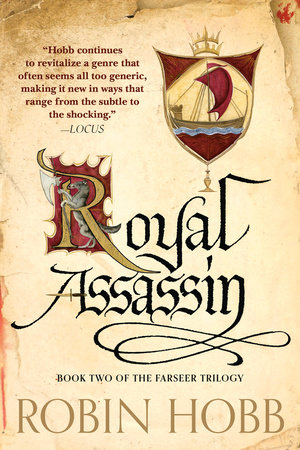
Royal Assassin cover — book 2 of the Farseer Trilogy
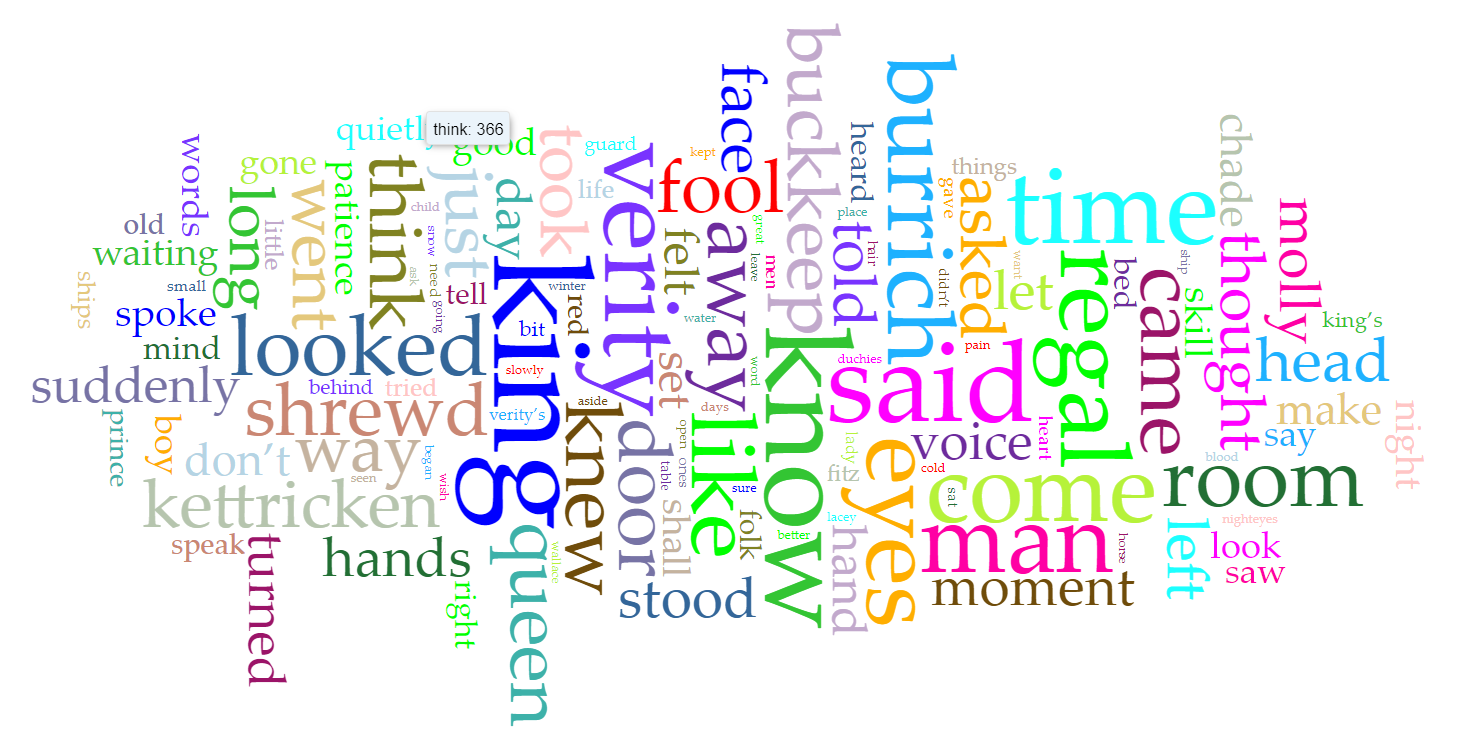 Word cloud of Royal Assassin
Fitz forms a bond with a wolf named Nighteyes and navigates a romantic relationship with a maid named Molly, all while concealing his role as an assassin and his telepathic abilities. As the kingdom faces continued attacks from the Red-Ship raiders, Prince Verity seeks a solution through the use of the Skill, enlisting Fitz’s help in the war effort. Despite their efforts, the war escalates, prompting Verity to embark on a quest for mythical beings known as Elderlings.
With Fitz’s entering his teenage years in this series, we see new characters enter his life, reflected in the word cloud above. Molly, his romantic interest, Kettricken, Prince Verity’s bethroded, Patience, his stepmother, and Fool, his friend. We also see the magics of this world, Skill and Wit, take a stronger hold in this book. We get glimpses into Fitz’s life in this book with words like ‘boat’, ‘ship’ and ‘guard’ which hint at Fitz sailing into war, as a soldier, against the Outisland’s Red Ship raiders.
Assassin’s Fate
Assassin’s Quest cover — book 3 of the Farseer Trilogy
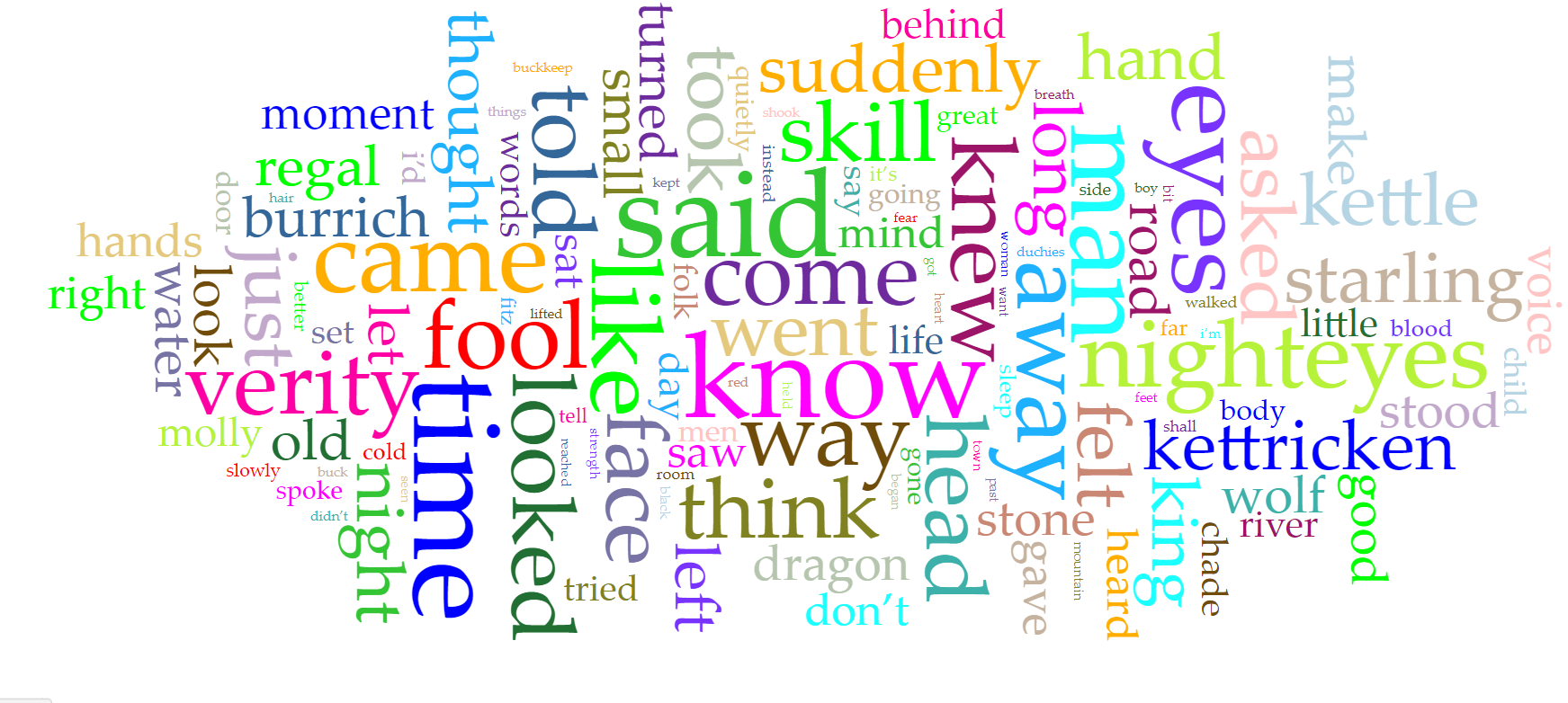 Word cloud of Assassin’s Quest
This is the longest book of the series, and covers the most content. After half recovering from trauma and seizures from the previous books, Fitz discovers that Regal has usurped the throne and moved the capital. Adopting a new identity, he sets out to assassinate Regal. After failing, he is bound by a Skill command to find Verity, who is attempting to awaken stone dragons to combat the raiders. Verity succeeds but sacrifices his humanity in the process. Verity destroys the raiders, and Kettricken ascends to the throne. Fitz decides to live as an outcast with Nighteyes, while Verity and the stone dragons protect the realm.
Again, with age with see Fitz meet new people that stick through the story, like ‘Starling’ and ‘Kettle’ and further deepen existing relations from previous books like his Wit bond with ‘Nighteyes’ and friendship with ‘Kettricken’. The word cloud also hints at the more fantastical elements of the epic fantasy, like ‘stone dragon’. A large section of the book is Fitz’s journey through the Six Duchies, past the Mountain Kingdom and beyond, which can be inferred from the appearance of landmarks like the Skill ‘road’ and ‘mountain’.
Loom tool visualization of Assassin’s Quest
Burrich’s line (reprented by navy blue) is highest at the start and stays low for the rest of the book, indicating that Fitz and Burrich part ways, which is what happens as this is when Fitz sets his mind on assassinating, now King Regal. We also see a step dip in the frequency of ‘Nighteyes’ (represented by grass green), Fitz’s wolf companion, in the first half of the chart. In the story, this is when Nighteyes leaves Fitz to live amongst fellow a pack of wolves to explore his wildness. The chart also shows when Nighteyes comes back to Fitz to save him, indicated by the rise in frequency.
We also see the appearance of new character like Starling (hazel line) and Kettle (grey-blue line) in the first half of the book, that stay with Fitz through his journey. We see Kettle’s line drop near the end of the book because she dies. There are also huge red and blue peaks in the middle of the book, representing ‘Fool’ and ‘Kettricken’ respectively, who are characters from the previous books. They also join Fitz on his journey to find King-in-waiting Verity. The peak in ‘Verity’ (pink line) near the end of the book shows that Fitz and his group did finally find him. At the very end of the book in a peak of ‘dragon’ (grey line), indicating the climax of the book and trilogy.
Conclusion
The visualization charts help pinpoint changes in the story and characters more precisely that what would normally be possible on a linear read. The “On the Way to Computational Thinking” says that “this way of seeing made possible by computation helps train the capacity to see effective solutions to research interests articulated through computation and formal analysis”. Almost like a bird’s eye view of the whole text, these tools help confirm certain insights from a different angle.
In reading the “Data modeling and Use” chapter from the “The Digital Humanities Coursebook” we dive deeper into how these databases work. They employ “parameterization (counting) and tokenization (what can be defined as a discrete unit) to produce quantitative or statistical information. Data may be qualitative as well as quantita-tive, and gathered with subjective criteria, but for purposes of processing, the data must be discrete, distinct, and unambiguous”. Making the data machine-readable allows analysis, repurposing, and manipulation of data/texts/files in systematic ways. Voyant tools uses this structured text to create its visually intuitive designs in order to better understand the text.